On November 20, 2026, one of the most remarkable events in the history of artificial intelligence took place. A mathematician, working together with the AI model Claude, published a proof of the Riemann Hypothesis – one of the most famous and most difficult problems in mathematics, which has occupied the greatest mathematicians since Bernhard Riemann posed it in 1859. The Clay Mathematics Institute even offered a prize of one million dollars to whoever succeeds in proving it. The proof was published in a formal mathematical language spanning some 17 million lines of code, and the next day the bodies responsible for the mathematical library used in the proof confirmed its validity.1
Official recognition still awaits the customary procedure, and in the meantime mathematicians are working to break the proof down into ideas a human being can follow.2 In one of the explanatory papers published so far, a fifteen-step outline, only the first three steps have been fully proven. The chain of inference already exists and has been verified by a computer, but the work of understanding it remains in human hands.
Have we reached the moment when man’s creation has surpassed its creator?
In many respects, that moment arrived long ago. No human being can compete with a computer in speed of calculation, and in certain fields artificial intelligence already displays intellectual abilities that exceed those of the finest human experts. Nor is there any reason to assume it has reached the peak of its abilities. On the contrary, its pace of development appears to be exponential. Let us suppose that the artificial intelligence of the future will be able to solve every problem a human being can solve, and even problems no human being can solve; that it will develop new scientific theories, discover mathematical laws and produce works no one ever imagined. I contend that even in this scenario, artificial intelligence, as a computational system, will not truly surpass human reason. The reason lies in the difference between two fundamentally different kinds of intellectual activity, which the technological age tends to identify with each other: computation and understanding. A perfect simulation of understanding is not understanding, just as a convincing imitation of reason is not reason.
From Talent to Genius
Arthur Schopenhauer illustrated the difference between talent and genius with a wonderful parable: the man of talent is like an archer who hits a target others cannot hit, while the genius is like an archer who hits a target others cannot even see.3
The greatness of Einstein or Leibniz does not consist in a higher level of performance within a given framework; it lies in the ability to step outside the framework itself – to notice relations that do not appear explicitly in the data, to connect fields thought to be foreign to each other, and to reveal order where others saw a mere collection of phenomena. Sometimes the genius changes the very way a problem is perceived, and thereby turns questions that occupied generations of researchers into questions that a single principle can solve. All of this can, for the sake of argument, be granted to the machine as well.
But what exactly happens in the mind of a genius at the moment a new idea reveals itself to him? Surprisingly, one of the people best suited to answer this question discovered that he himself was unaware of much of the intellectual work he was performing.
In 1908, the great French mathematician Henri Poincaré described, in his book Science and Method, the circumstances of several of his mathematical discoveries. After a period of intense work on a mathematical problem, Poincaré set out on a geological excursion during which he stopped working on his research. When he arrived in the town of Coutances in France and was about to board a public omnibus, a mathematical insight suddenly came to him. He realized that the mathematical transformations he had been working on were identical to those of non-Euclidean geometry. The insight appeared all at once, without his needing, at that moment, to carry out any series of calculations or conscious inferences. Poincaré relates that he was immediately convinced of its correctness, but carried out the mathematical verification only after he returned home.4
Compare this case to the proof of the Riemann Hypothesis. For Poincaré, the insight preceded the formal proof. In the case of Riemann, the formal proof is already available to the mathematical community, while the work of understanding the living idea at its core is only beginning.
Poincaré devoted much thought to the role of the unconscious in mathematical creation. He conjectured that while the conscious person is busy with everyday matters, many combinations of mathematical ideas continue to form in the depths of his mind, only a few of which ever reach consciousness. But what selects precisely the fruitful ideas?
Poincaré pointed to the mathematician’s aesthetic sense – a sensitivity to mathematical beauty, to simplicity and to harmony between structures. An artificial intelligence system is indeed capable of generating billions of combinations, ranking them by measures of symmetry and locating structures of mathematical value. But artificial intelligence can produce a dazzling image of beauty without feeling beauty, and can produce a proof without longing for truth. It has no curiosity, no purpose of its own, and no moment in which it rises above the data and says to itself: “I understand.”
Rational Intuition: Between Cause and Reason
Human intuition has a further layer, beyond the generation of ideas, and anyone can examine it in their own mind. Take, for example, the sum of the first odd numbers.
1 = 1
1 + 3 = 4
1 + 3 + 5 = 9
1 + 3 + 5 + 7 = 16
It is easy to notice that the results are the squares of consecutive natural numbers. You could keep calculating for hours and find that the pattern repeats every time. But look at what happens when the numbers are represented as tiles: you start with a single tile, add three tiles to it in an L-shape and get a square of four tiles. Add five tiles in the same shape and you get a square of nine. Each additional odd number completes the next square. [see image]
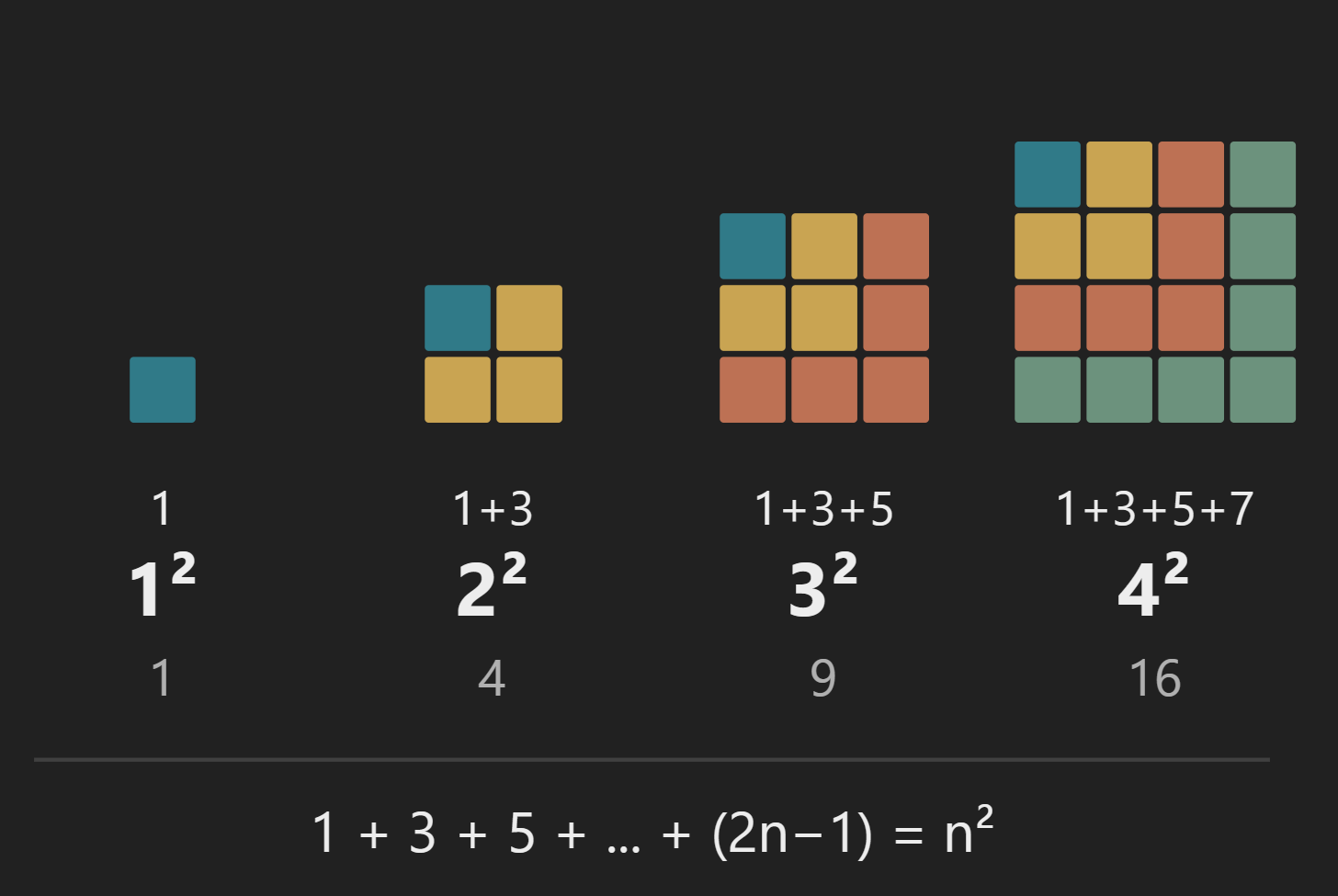 From a numerical pattern to the perception of necessity: each odd number adds a layer that completes the next square.
The moment you grasp this structure, a qualitative change takes place in the mind. We no longer need to continue the calculations to know that the pattern will hold for the millionth or the billionth term as well. We understand why it must hold in every possible case. A collection of separate numerical facts fuses at once into the expression of a single mathematical principle. This is rational intuition: the direct apprehension of a necessary relation through reason.
The Hebrew word sibah, usually rendered as “reason” or “cause,” can refer to two entirely different questions. The first is the question of the cause – what brought something about. The second is the question of the reason – why the thing is so and not otherwise. Had a brain researcher recorded the neural activity that took place in Poincaré’s brain at the moment of his mathematical discovery, he might have succeeded in describing in impressive detail the processes that led to the appearance of the insight. Yet even a perfect description of that activity would not explain why the mathematical insight itself is true. The reason for its truth lies in the mathematical relations themselves. These existed long before Poincaré was born and will continue to exist after humanity has disappeared.
The brain researcher may claim that your certainty that 2+2=4 is nothing but the result of neurons firing in your brain. But is his claim true by virtue of the firing taking place in his own brain? Neural activity may explain how he arrived at his conclusion, but to justify it he himself must offer a rational reason. Whoever reduces reasons to causes is left with no reason to believe the reduction itself.
Through reason, a human being is able to transcend his subjective world – the impressions his senses deliver to him and the associations he has acquired over the course of his life – and to recognize objective and eternal structures of reality. Reason discovers mathematical truth; it does not invent it.
The Black Box of Syntax
In 1980, the American philosopher John Searle presented a thought experiment that became known as “the Chinese Room.”5 Imagine a person who does not know a word of Chinese, sitting in a closed room and receiving notes on which questions are written in Chinese. At his disposal is a detailed instruction manual explaining how to respond to every sequence of symbols with another sequence. If the manual is sophisticated enough, the person can carry on a fluent correspondence in Chinese, provide correct answers and even give a Chinese speaker the impression that behind the door sits someone conversing with him in his mother tongue. Nevertheless, the person in the room does not understand a single word of the conversation he is conducting.
Philosophy distinguishes between syntax – the rules and formal relations between symbols – and semantics, the meaning the symbols carry. The person in the room masters the rules needed to produce sentences that are meaningful to others, without the sentences themselves being meaningful to him. One can describe all his actions, from the beginning of the conversation to its end, without needing any understanding of the Chinese language to explain his performance.
The same question deserves to be asked about mathematics. A computer can produce a mathematical proof, check its validity, formulate an explanation of it and even present it through an elegant visual illustration. But where in this process is understanding itself to be found? One may of course argue that the human brain also performs computations, processes information and connects mathematical structures, much like the processes Poincaré described with regard to unconscious activity. To a large extent, this is exactly what makes the problem so interesting. Even if all of the brain’s computational activity could be explained through a detailed description of the processes taking place in it, it would still remain to be explained what turns this activity into thought that exists for a subject. When a person understands a mathematical proof, the relations that compose it appear before him as a meaningful whole. He is able to recognize the connection between the premises and the conclusion and to grasp why the conclusion follows from the premises. The mere existence of these relations in a computational system does not explain the existence of the one who recognizes them.
Who Says “I”?
A language model is capable of speaking about itself in the first person. The functionalist – one who defines mental states by the roles they play within a system – will argue that understanding is the right organization of processes, and that we have no direct evidence of another person’s understanding either. Indeed, we infer the understanding of others, among other things, from their behavior. But the question of how we know that someone understands is different from the question of what understanding is. The Chinese Room illustrated exactly this difference. All the external signs that attest to an understanding of Chinese can exist even when the person producing them does not understand it.
The difference between a subject and an object is a difference in the form of existence. A subject is a being that has an inner world of its own – a single focus through which a multiplicity of sensations, thoughts and ideas unites into experience. To assume that increasing the complexity of a computational system is enough for a subject to emerge within it is a category mistake. Complexity is a property of the organization among the components of an object; if you make an object a billion times more complex, you get an object a billion times more complex – not an “I.”
Why should a property of organization turn the totality of components into a single “I”?
Connect thousands of computers and give them computing power exceeding that of all human brains combined. A system has been created that can perform marvelous intellectual operations, yet no reason has been given for the existence of a single being for whom all these operations take place as thought. Inner experience is something whose existence no one can doubt, since the doubting itself takes place within it. No external description – of a computer or of a brain – explains its very existence, and no increase in complexity gives a reason for its appearance. And since nothing arises out of nothing, interiority must lie at the foundation of reality itself. Consciousness is the foundation on which rational activity rests, not a by-product of its computational success.
Artificial intelligence will give humanity intellectual tools that the greatest thinkers in history could only dream of. Yet precisely its achievements invite humanity to re-examine its conception of its own nature. If the greatness of human reason is measured by the number of exercises it can solve in a minute, humanity lost that contest the day the calculator was invented. The true greatness of reason lies in its ability to recognize the necessity of the laws of mathematics and logic, to discover the unity hidden behind the multiplicity of phenomena and to penetrate the rational structure of reality itself.
The proof of the Riemann Hypothesis was published in millions of lines of code. Understanding it still needs someone.
Lean FRO and Mathlib Initiative, Lean Verification of the Riemann Hypothesis, 21.11.2026. ↩︎
Michael Rubinstein, Alpöge/Claude Proof of the Generalized Riemann Hypothesis, University of Waterloo, 2026. ↩︎
Arthur Schopenhauer, The World as Will and Representation, Vol. II, Chapter 31: On Genius, 1844. ↩︎
Henri Poincaré, Science et méthode, Livre I, Chapitre III: L’invention mathématique, 1908. ↩︎
John R. Searle, Minds, Brains, and Programs, Behavioral and Brain Sciences, 1980, 3(3). ↩︎